

Manage CAB Settings
Administer the app from one place
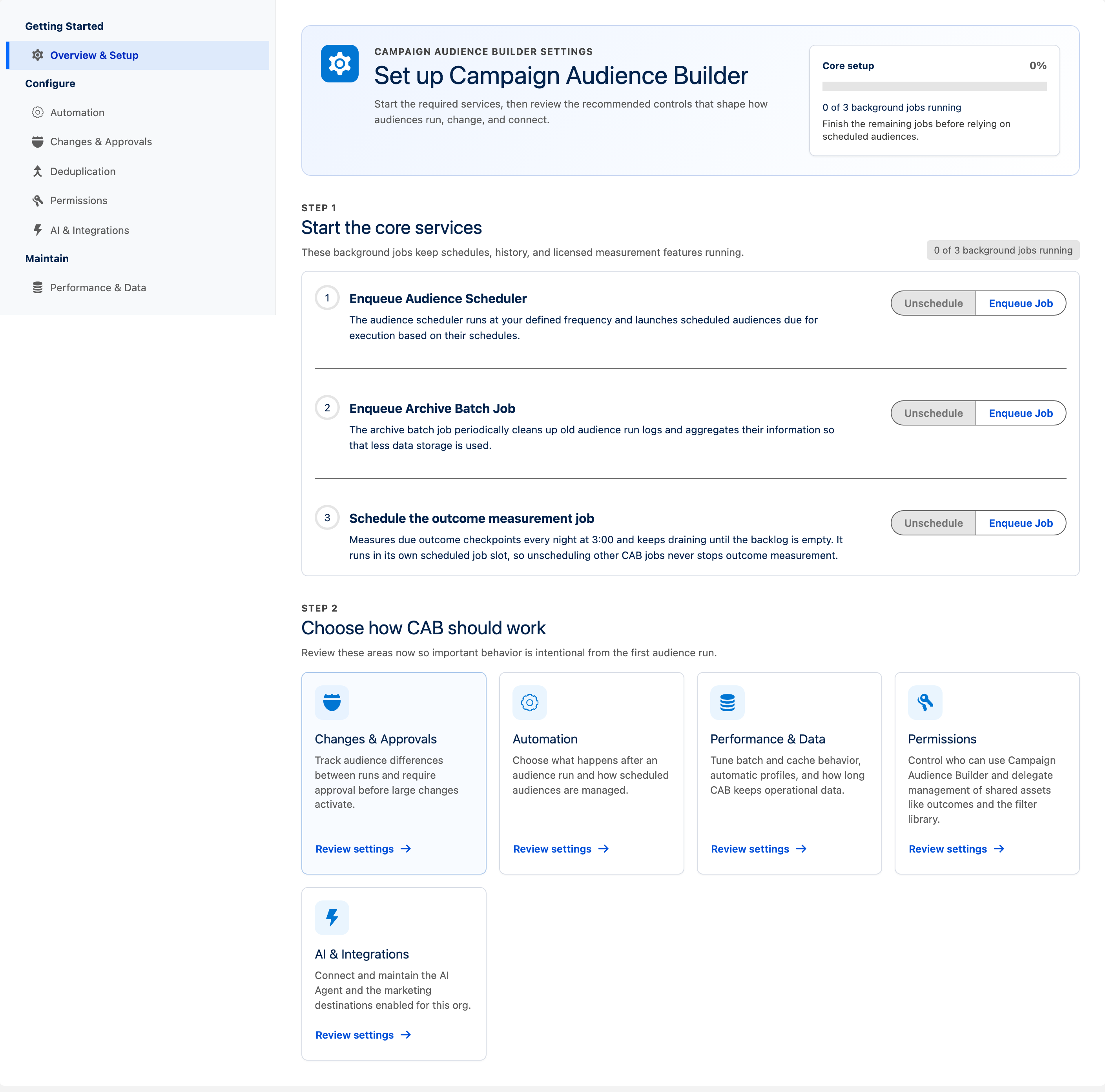
Open the CAB Settings tab to start required jobs and manage organization-wide CAB behavior. The interface is organized by administrative goal: Getting Started, Configure, and Maintain.
Find a setting
Section titled “Find a setting”| Navigation group | Page | What it controls |
|---|---|---|
| Getting Started | Overview & Setup | Required background jobs and setup progress. |
| Configure | Automation | Final Actions and scheduler behavior. |
| Configure | Changes & Approvals | Run-to-run change tracking and change-approval policy. The page header is Auditability & Governance. |
| Configure | Deduplication | Per-object rules that remove duplicate records from audience results. |
| Configure | Permissions | Who can use CAB, and who may manage shared assets. |
| Configure | AI & Integrations | Cabby, Account Engagement, and Marketing Cloud setup when those features are available. |
| Maintain | Performance & Data | Cache, result persistence, batch sizes, composition profiles, and retention. |
| Maintain | Outcome storage | Measuring on/off, the capture storage limit, and how long completed member populations stay available. |
| Maintain | Audience Query Diagnostics | Generated SOQL and large-data-volume filter risks when diagnostics are included in the edition. |
Only pages relevant to the enabled CAB edition and integrations are shown.
Start the core services
Section titled “Start the core services”On Overview & Setup, the Core setup panel tracks how many of the available background jobs are running:
- Enqueue Audience Scheduler launches scheduled audiences as they come due. Use Enqueue Job to start it and Unschedule to stop it.
- Enqueue Archive Batch Job cleans up old audience run logs and applies the configured retention limits.
- Schedule the outcome measurement job appears when Outcome Tracking is available and measures due checkpoints.
Choose how CAB should work
Section titled “Choose how CAB should work”Below the core services, Choose how CAB should work links to the areas worth deciding before the first audience run. Each card opens its page with Review settings:
- Changes & Approvals — track differences between runs and require approval before large changes activate.
- Automation — choose what happens after an audience run and how scheduled audiences are managed.
- Performance & Data — tune batch and cache behavior, automatic profiles, and how long CAB keeps operational data.
- Permissions — control who can use CAB and delegate management of shared assets.
- AI & Integrations — connect and maintain the AI Agent and the marketing destinations enabled for this org.
Configure automation
Section titled “Configure automation”CAB Settings → Automation
The upper part of the page manages Final Actions. Under Scheduler Settings, administrators can:
- turn on Automatically remove recurring schedules targeted on inactive campaigns;
- turn on Automatically remove recurring schedules targeted on past campaigns;
- choose Which sharing context should be used during scheduled audience runs?: Audience Owner or Job User.
Remove duplicate records
Section titled “Remove duplicate records”CAB Settings → Deduplication
Define ordered match-field rules per audience object so that runs collapse duplicate records before they are counted or activated.
Participating is the default, so activating a rule changes every audience built on that object at once — except the audiences where deduplication was turned off. A new or changed rule applies from each audience’s next run; a run already under way keeps the rules it started with. The page states this above the rules.
Deduplication also adds a little to how long a run takes. For most audiences the difference is small; audiences with many duplicates spend more time on it.
See Deduplication for the rules, the per-audience setting, and the removal details on a run.
Manage access and delegation
Section titled “Manage access and delegation”CAB Settings → Permissions
Under Access, assign the permission set groups that grant CAB itself: Administrators, Users, and Users without automations.
Under Delegated management, grant curation of a shared asset without full administrator access: Outcome Management and Filter Library Management. Assign these in addition to a user’s regular CAB access.
Deduplication rules are not delegable. A rule decides which records leave a segmentation result, so only CAB administrators can create, reorder, or delete them. Everyone with regular CAB access can read the rules, which is what the per-audience summary needs.
Configure performance and retention
Section titled “Configure performance and retention”CAB Settings → Performance & Data
Under Advanced Settings, CAB can expose these controls depending on the edition:
- Store audience results in the Platform Cache to improve segmentation performance and the related result-persistence options;
- Batch Size for asynchronous campaign member creation;
- Automatically compute composition profiles after each run.
Under Data Retention Settings, set both age and record-count limits:
- Number of days to retain Audience Run records as run history;
- Maximum number of Audience Run records to retain as run history;
- Number of days to retain Data Extension Addition Request records;
- Maximum number of Data Extension Addition Request records to retain.
CAB keeps a record only while it is inside both applicable limits. Review these values against your audit requirements before reducing them.
Control what outcome measurement stores
Section titled “Control what outcome measurement stores”CAB Settings → Maintain → Outcome storage
Outcome storage has two separate controls: a limit on the member data captured for measurement, and a retention period for populations whose last checkpoint has finished. The first controls growth; the second determines how long individual results remain available for inspection and future targeting.
Switch measuring on or off
Section titled “Switch measuring on or off”The header states whether measuring is on. Switching it on opens the storage-limit setup and schedules the nightly checkpoint job. Switching it off asks for confirmation and stops that job. Audience activations continue, but new captures are not stored for measurement while it is off.
Set the limit
Section titled “Set the limit”Under The limit, inside your org’s storage, set Limit (MB) and Warn at (%), then select Save. The default limit is one fifth of the org’s allocation. Saving deploys a setting and can take a minute to apply. The page states when usage was counted; small demonstration datasets can round to 0 MB.
Activation snapshots and Conversion matches count against this limit. The breakdown also shows supporting records, including Conversion timing, marked Not counted against the limit. They still occupy Salesforce storage; they are outside this particular capture limit.
Keep measured populations available after the final checkpoint
Section titled “Keep measured populations available after the final checkpoint”Under How long measured populations remain available, set Keep for (days after the last checkpoint) and select Save. Use the maximum shown for your organization.
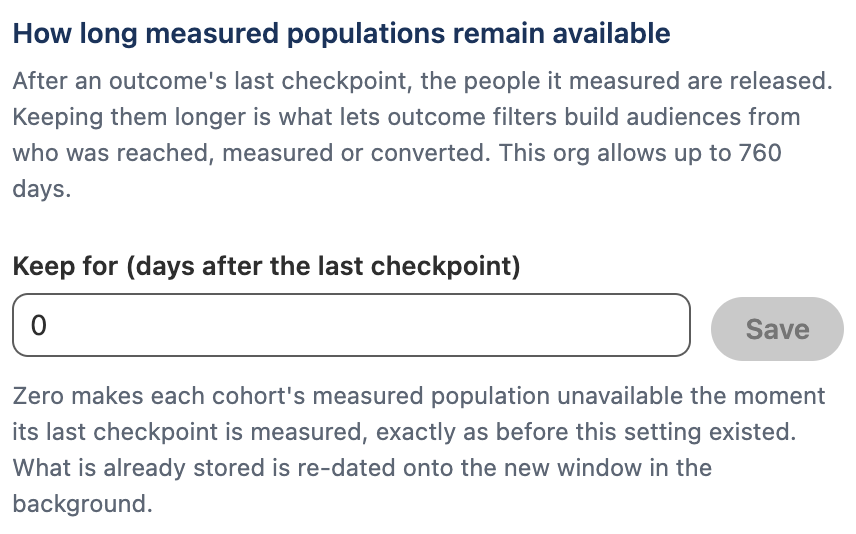
This screenshot shows the English interface in the showcase org. No post-checkpoint retention has been added.
- Zero days, the default: the population becomes unavailable when its final checkpoint is measured.
- A longer period: completed populations remain usable for member inspection and the outcome filters that depend on reached, measured, or converted members.
- A shorter period: CAB previews affected populations and asks for confirmation. Populations already outside the new window become unavailable; dependent audience filters can return fewer members. Release is performed by nightly cleanup and cannot be undone.
Changes are applied to data still stored in the background. Extending retention does not restore data already released. A broad historical date filter cannot recover people whose measured population is gone.
Aggregate checkpoint results and Conversion timing can outlive per-person evidence. This is why an outcome can still show historical conversions when its member list is no longer available. These are different retention needs; a visible historical rate does not guarantee a usable population for Act on it.
Stop tracking or delete what one activation holds
Section titled “Stop tracking or delete what one activation holds”Under Where the weight sits, select Manage to inspect the campaigns or lists holding measurement data.
- Stop tracking removes the outcome assignments from capturing actions for that destination. Existing populations continue through their checkpoints and retention lifecycle. You can assign outcomes again later.
- Delete starts a background purge of the stored measurement data for that destination. Dependent results become unavailable as it completes. This is irreversible and is different from ordinary post-checkpoint retention.
Both actions ask for confirmation. If there is no standing assignment to remove, only Delete is offered.
See Outcome measurement for the result states and evidence views, and Use the result in your next audience before choosing a retention period for follow-up work.