

Let Cabby help define and explain outcomes
Turn results into guidance
Cabby now helps at both ends of the loop: it can draft a conversion definition before measurement starts, and—when an admin opts in—it can use aggregate outcome history to rank ideas and explain measured performance in your organization.
Cabby · Aggregate-only · Explicit data opt-in
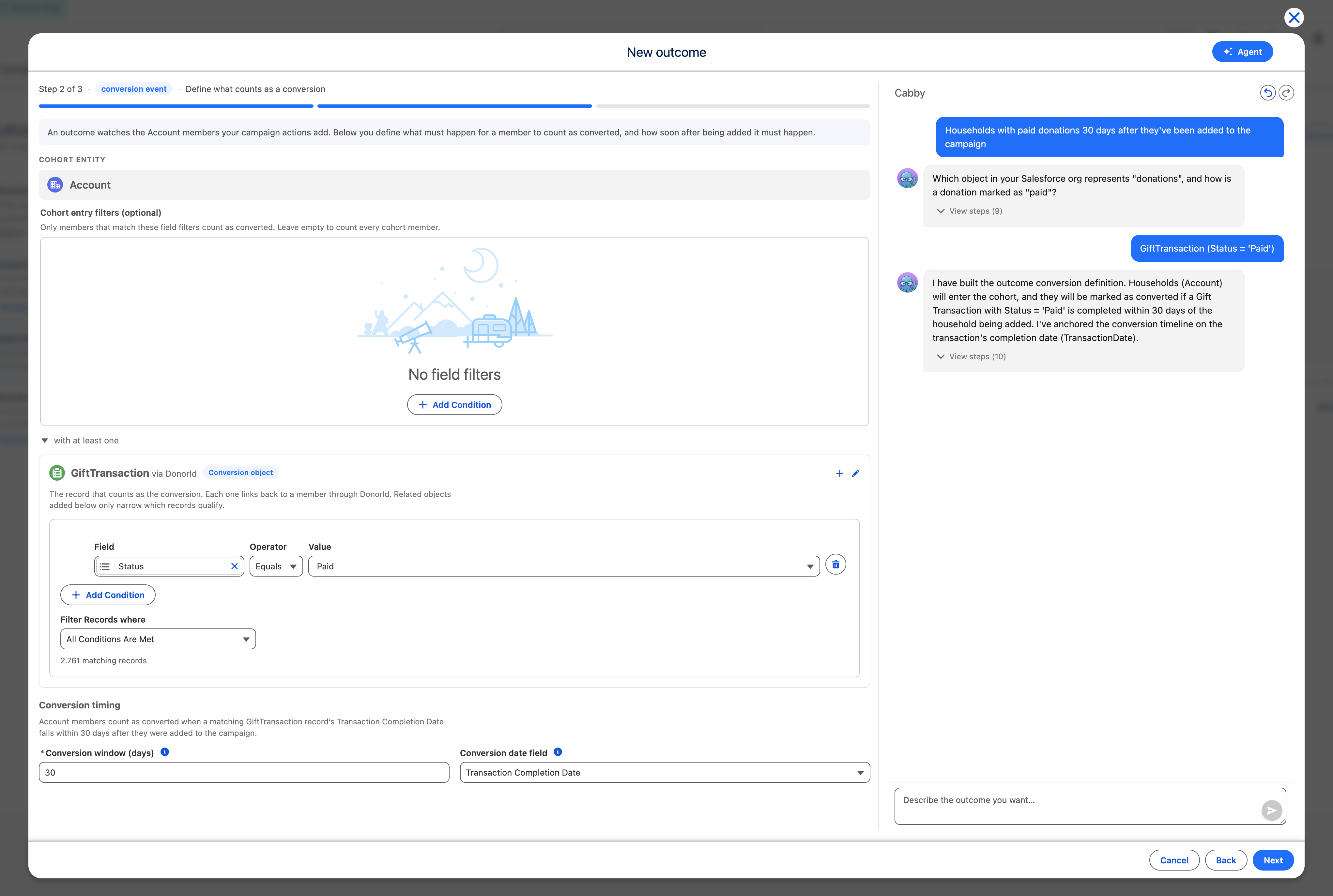
Ask Cabby to draft a conversion rule
Section titled “Ask Cabby to draft a conversion rule”- In CAB Outcomes, create or edit a conversion outcome and continue to Define what counts as a conversion.
- Select the visible Agent button. The panel title is Cabby.
- Describe the goal in Describe the outcome you want…. Cabby can choose the conversion object, relationship path, date field, window, and filters.
- Review the live draft, use Undo or Redo, complete the remaining measurement fields yourself, and select Save outcome.
Authoring needs the Segmentation Agent but does not require outcome-data sharing. Cabby cannot set the outcome name, description, checkpoints, listening scope, Filter Library references, or aggregate rules.
Ask why performance looks the way it does
Section titled “Ask why performance looks the way it does”- In CAB Outcomes, select an outcome and choose Let Cabby explain the performance.
- In an audience’s Run History, open Outcome measurement and choose Let Cabby explain this send's performance.
- From the audience action bar, open Outcomes; its Cabby card generates a short explanation of the result being shown.
- Use Regenerate with the current measured data after newer checkpoints arrive.
Outcome-aware ideation and main chat use the same evidence digest, so questions such as “what has been working for us?” can be answered from your organization’s measured history rather than generic patterns.
Trust and privacy
Section titled “Trust and privacy”- Only outcome definitions and aggregate audience-send checkpoint facts are shared.
- Individual names, emails, record IDs, and member or converter lists do not leave Salesforce.
- Data stays in the organization’s private backend space and is not used for model training.
- Small samples are excluded, older evidence fades, approximate attribution carries less weight, and wording stays correlational.